The Pattern Files - ISSUE NO. 02: The Blueprint Discrepancy
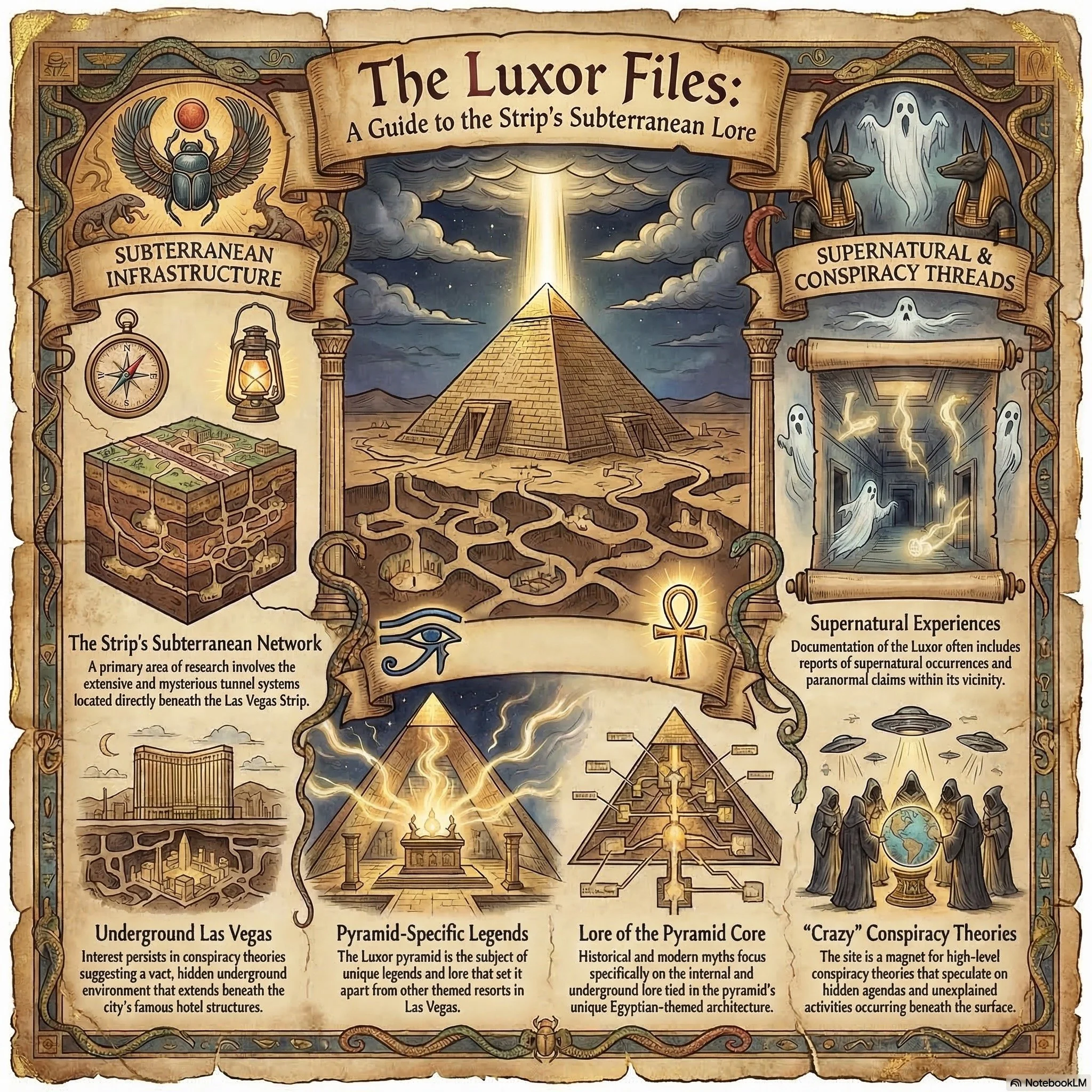
Infographic titled The Luxor Files: A Guide to the Strip's Subterranean Lore. Parchment-style illustration showing the Luxor pyramid at center surrounded by six panels covering underground tunnel networks, pyramid legends, supernatural experiences, and conspiracy theories. Features Egyptian motifs, ghosts, UFOs, and robed figures. Created with NotebookLM.
ISSUE NO. 2 — THE BLUEPRINT DISCREPANCY
In 1993, a casino company broke ground on a thirty-story glass pyramid in the Nevada desert. They said it was a hotel. They said the beam of light shooting from the apex into the night sky was just good branding — thirty-nine xenon lamps at seven thousand watts each, focused through curved mirrors, producing 42.3 billion candlepower. A lighthouse for people who wanted to lose money.
Nobody asked why you'd build a pyramid in a city named for meadows that don't exist anymore. Nobody asked why the sub-basement levels on the original blueprints — the ones filed with Clark County in 1991 — don't match the sub-basement levels that were actually built. Nobody asked because nobody was supposed to.
I asked.
The Filing
November 14, 1991. Circus Circus Enterprises announces a $290 million resort shaped like the Great Pyramid of Giza. The architect is Veldon Simpson. The general contractor is Perini Building Company. The timeline is eighteen months. For context: eighteen months to build a thirty-story pyramid with the world's largest atrium — twenty-nine million cubic feet of open interior space — is not ambitious. It's suspicious.
The plans filed with Clark County describe a structure at 3900 Las Vegas Boulevard South. Three hundred and fifty-seven feet tall. A sphinx out front — one hundred and six feet high, two hundred and sixty-two feet long, facing the Strip like it's been there for millennia. Inside: 2,526 rooms, a casino floor, a fifteen-minute boat ride called the Nile River Tour that would circle the interior with pieces of ancient Egyptian artwork, and an atrium so vast that the structural loads would have to travel diagonally down through reinforced concrete walls rather than traditional columns, averaging nine kips per square foot on the foundations.
That last detail matters. When you can't use conventional interior supports, you have to go deep. The question is: how deep did they go?
The Discrepancy
Clark County building inspectors found two unfinished concrete support columns in the pyramid's basement that were not part of the original building plans. County documents noted that their completion "will not fully resolve structural repair requirements."
Read that sentence again.
Two columns. Not in the plans. Partially cast. And finishing them wouldn't fix whatever they were supposed to fix.
The project generated 1,129 correction notices and notices of violation from county inspectors. One thousand, one hundred and twenty-nine. The chairman of Circus Circus — a man named William Bennett — claimed county officials were "overly critical" of the pyramid design and had imposed "unnecessarily strict fire precautions" that added significant costs. The budget swelled from $290 million to $375 million. Workers died during construction. The building went up anyway.
The pyramid opened on October 15, 1993. Three thousand five hundred construction workers. One hundred and fifty contractors. Eighteen months. And two columns nobody planned for.
The Light
The Sky Beam went operational on opening night. Thirty-nine xenon lamps firing through curved mirrors, visible from aircraft two hundred and seventy-five miles away — from cruising altitude over Los Angeles, you could see it. The claim that it was visible from space was never technically true, but they let people believe it anyway. Nobody corrects a story that makes them sound more powerful than they are.
The beam attracts moths. The moths attract bats. The bats attract owls. A food chain built on artificial light, three hundred and fifty-seven feet above the desert floor.
By 2008, they cut the beam in half. Twenty-one lamps instead of thirty-nine. Cost savings, they said. Fifty-one dollars an hour at full power, twenty of which was electricity. The most powerful beam of light on the continent, and they halved it to save fifty-one dollars an hour.
Or they halved it because someone decided it was attracting the wrong kind of attention.
The Erasure
Here is where the pattern becomes undeniable.
Between 2007 and 2009, the Luxor underwent a systematic de-theming. Nearly $300 million spent — not building, but removing. The Nile River Tour, which had operated for only three years before being dismantled. The King Tutankhamen exhibit. The talking animatronic camels. The hieroglyphics. The twelve-thousand-square-foot Egyptian museum, closed permanently in June 2008. Eighty percent of the Luxor's public areas were remodeled. Every trace of Egypt — except the pyramid itself and the sphinx — was stripped.
MGM Resorts International, which had acquired Mandalay Resort Group in 2005, called it modernization. They replaced pharaohs with nightclubs. They replaced antiquity with bottle service.
But you don't spend $300 million erasing a theme. You spend $300 million erasing evidence.
The Question
The original plans are public record. The amended plans are public record. The 1,129 correction notices are public record. The two unfinished columns that weren't supposed to exist are public record. The question isn't whether any of this happened — it did, it's documented, you can look it up — the question is whether anyone has ever placed these facts next to each other and asked what they look like as a sequence.
A pyramid goes up in eighteen months. The blueprints don't match the building. Columns appear that nobody planned. Over a thousand violations are documented and waved through. A beam of light punches into the sky at 42.3 billion candlepower. Three years later, they start removing every piece of the original interior. A decade later, they remove the rest. The beam gets cut in half.
What was the Luxor before it became a casino?
What is it now that it's stopped pretending to be one?
The Pattern File publishes when the pattern demands it. Issue No. 3 — The Recruitment Corridor — is in progress.
If you're tracking this, subscribe to The Broadcast.