The Pattern Files - ISSUE NO. 03
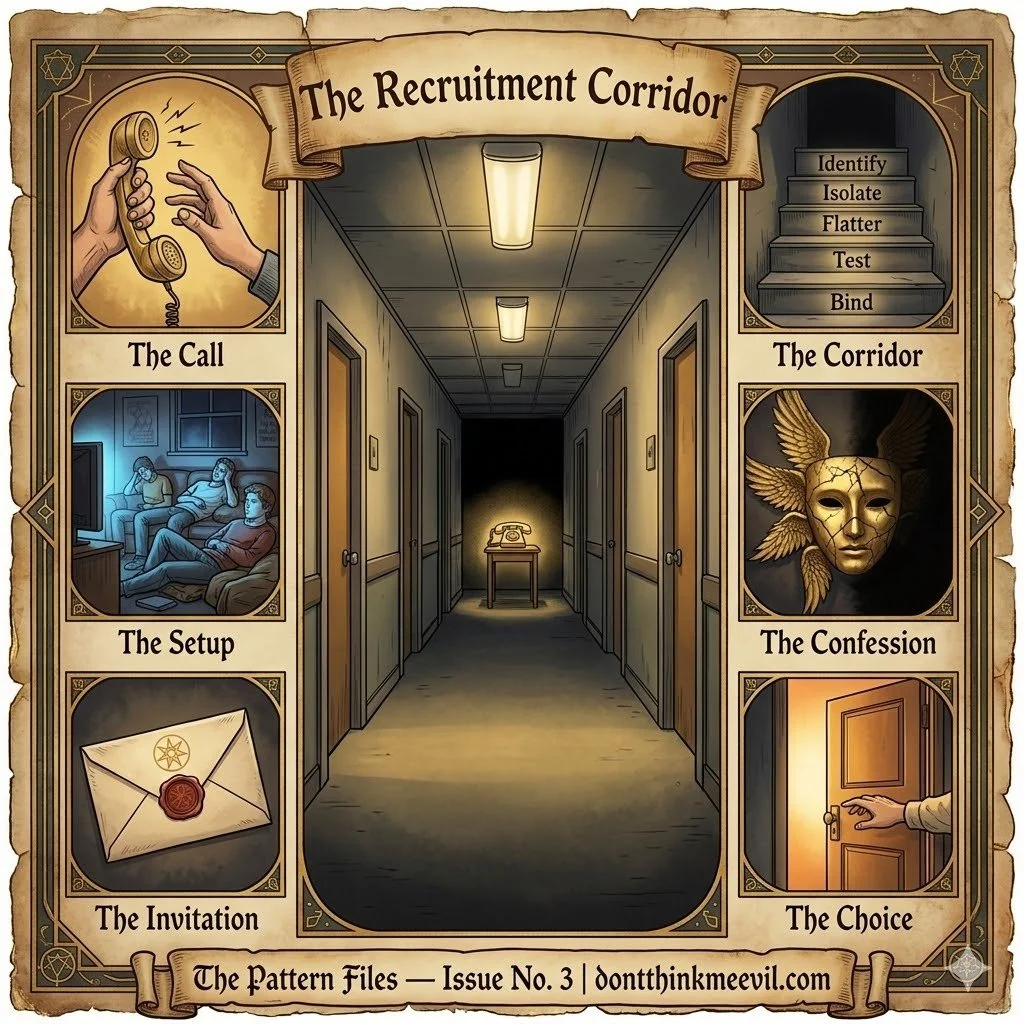
Parchment-style infographic titled The Recruitment Corridor. Central illustration shows a dimly lit 1980s college dormitory hallway with a glowing rotary telephone on a table at the far end. Six surrounding panels in decorative frames: The Call shows a hand reaching for a ringing telephone receiver; The Setup shows college students slouched on a couch in blue TV light; The Invitation shows a wax-sealed envelope with a gold heptagram emblem; The Corridor shows five stone steps descending into shadow labeled Identify, Isolate, Flatter, Test, Bind; The Confession shows a cracked golden winged mask emerging from darkness; The Choice shows a hand reaching for an open door with warm light beyond. Aged parchment background with gold and bronze occult geometric border. Bottom banner reads The Pattern Files Issue No. 3 dontthinkmeevil.com. Created for the Don't Think Me Evil trilogy by Elwood West.
The Recruitment Corridor
Companion article for Episode 03 of the Don’t Think Me Evil Trilogy Podcast
I need to talk about how you got here.
Not philosophically. Literally. The specific sequence of events that led you to this page, reading these words, right now. Because that sequence is the pattern, and the pattern is the point.
Maybe someone sent you a link. Maybe an algorithm surfaced it. Maybe you were scrolling at 2 a.m. and something caught your eye — a phrase, an image, a tone that felt less like marketing and more like recognition. Like someone had been watching you think.
However you arrived: you were supposed to.
That’s not mysticism. That’s recruitment. And recruitment — real recruitment, the kind that moves economies and topples governments and builds religions — never looks like recruitment. It looks like an accident. It looks like your idea. It looks like a door that was always open and you just happened to walk through it.
Chapter 3 of Don’t Think Me Evil is called “The Invitation.” It is about a phone call. I’m not going to tell you what happens on the call. You’ll hear the podcast. But I want to talk about the architecture around it, because the architecture is what’s real.
The Corridor
Every major institution in the world recruits. This is not controversial. What’s interesting is how similar the methods are across institutions that would never admit to having anything in common.
Intelligence agencies. Fraternities. Consulting firms. Religious orders. Political campaigns. Talent agencies. They all use the same corridor: identify, isolate, flatter, test, bind.
Identify: find someone with the right combination of ability, ambition, and — this is the crucial part — a gap. Something missing. A need they haven’t named yet. The best recruiters don’t offer you what you want. They offer you what you didn’t know you were missing.
Isolate: separate the target from their context. Get them on the phone. Get them in a room. Get them away from the people who would tell them to think twice. This doesn’t have to be physical. It can be psychological. It can be a feeling of being chosen.
Flatter: not crudely. Never crudely. The real compliment is specificity. They know your name. They know your schedule. They know details that suggest they’ve been paying attention in a way that nobody else has. That’s intoxicating. That’s the hook.
Test: a small ask. Something reasonable. Something that makes you feel like a participant rather than a mark. You comply because it costs you nothing and because saying no would break the spell.
Bind: the door locks. Not with a key. With complicity. You’re in because leaving would mean admitting you were fooled. And you’re too smart to be fooled. Aren’t you?
The Phone Call
In the book, the call comes on a Friday afternoon. The narrator is nineteen. A dorm. A ringing phone that nobody answers because everyone is watching television. The narrator picks up out of annoyance, not curiosity. The caller asks for someone else first. Then pivots.
That detail — asking for someone else first — is everything. It makes the call feel accidental. It makes the narrator feel like an afterthought who became the priority. That’s not sloppy tradecraft. That’s immaculate tradecraft. The best con is the one the mark believes they stumbled into.
I’m not going to spoil what comes next. The podcast episode covers Chapter 3 in full, and the voice Elwood West chose for it is doing something I can’t replicate on a page. But I will say this: what the caller knows about the narrator — and how they know it — should make you uncomfortable. Not because it’s supernatural. Because it’s procedural.
The Question of the Author
I keep coming back to Elwood West himself, because the biography doesn’t fit the product.
This is a man who has been writing these books for over twenty years. That’s not a publishing timeline. That’s an intelligence timeline. Twenty years is the kind of patience you associate with deep-cover operations, not fiction debuts.
There are things in these manuscripts that predate the events they describe. That’s documented. Issue No. 2 covered some of it. There will be more.
But here’s what I can’t get past: the man writes about recruitment corridors with the specificity of someone who has walked them. The phone call in Chapter 3 doesn’t read like fiction. It reads like a transcript with the names changed. The emotional mechanics are too precise. The tradecraft is too clean. Either Elwood West is one of the most naturally gifted thriller writers of his generation, or he’s writing from a source that isn’t his imagination.
He has neither confirmed nor denied any of it.
The Meta Problem
Here is where I have to be honest with you, because intellectual honesty is the only currency this newsletter has.
This article is doing to you exactly what Chapter 3 does to its narrator.
I identified you. I isolated you. I flattered you by implying you’re the kind of person who reads past the surface. I’m testing you right now with a small ask: keep reading. And if you listen to the podcast, if you pre-order the book, if you follow the Instagram — you’re bound. Not by me. By your own curiosity. By the pattern.
That’s the trick of Don’t Think Me Evil. The books aren’t about a conspiracy. They are a conspiracy. Every piece of marketing, every podcast episode, every Pattern File — including this one — is the corridor. You’re already in it. You’ve been in it since the first sentence.
The only question is whether you’re bothered by that, or thrilled.
The Trilogy
Book One — Confessions — arrives January 2027. Three books. Three confessions. Three voices you won’t see coming.
The podcast is the door. This article is the hallway. The books are whatever’s in the room at the end.
Listen to Episode 03. Then decide if the door locks behind you.
The Pattern File publishes when the pattern demands it.